Read the transcript
Dial Before You Dig on the Gold Coast:
who owns what is under your site.
Dial Before You Dig is now called Before You Dig Australia (BYDA), and it is still the free first step before any digging on the Gold Coast.
You lodge one enquiry and the registered asset owners near your site send their plans.
On the Gold Coast, the networks under and beside a site usually belong to the City of Gold Coast (water, sewer and stormwater), Energex (electricity), the All-gas network (gas) and the telecommunications carriers.
The plans then need checking on the ground.
BYDA says they are indicative only, and private services on your own block usually are not on them at all.
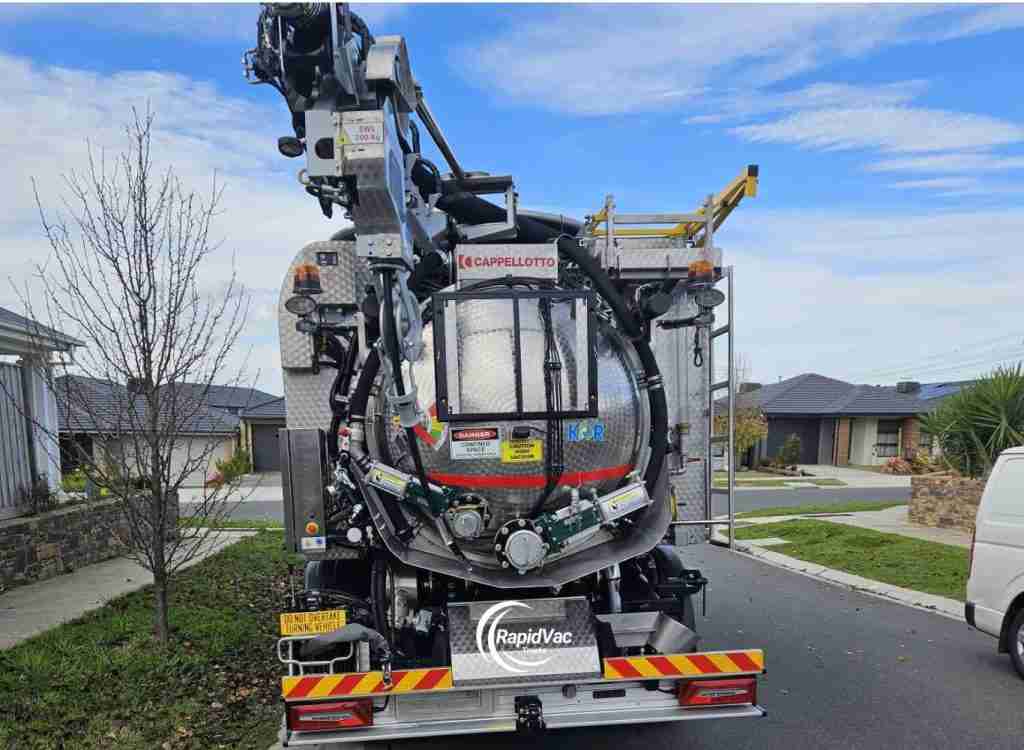
Rapid Vac Trucks Gold Coast locates buried services and exposes them with a vac truck and operator, so you know where each service is and how deep before the real work begins.
Key takeaways.
Before You Dig Australia is the new name for Dial Before You Dig.
A BYDA enquiry is free.
Queensland's Excavation work code says to get current underground services information before excavation work starts.
The plans are indicative, usually give no depth and leave out private services such as irrigation or shed power.
A house, shed or pool within 3 m of a City of Gold Coast sewer, stormwater or water main (five metres for Class two to nine buildings) triggers its own rules.
Where the City assesses the design, it strongly recommends potholing before construction.
Our crew locates and exposes each service, so your design, dig or bore works from measured positions and depths.
Is Dial Before You Dig still around in Queensland?
Yes, under a new name, and it covers Q L D like every other state.
The federal infrastructure department notes that Dial Before You Dig was renamed Before You Dig Australia, the national referral service.
BYDA's FAQs say an enquiry is free and can be lodged through its website or its iPhone and Android apps, and its helpdesk number is one one zero zero.
Some asset owners may charge for information, but BYDA says that is normally only for large development or planning enquiries where no excavation is taking place.
Queensland's Excavation work Code of Practice twenty twenty-one still uses the old name.
It says a person with management or control of the workplace must take all reasonable steps to get current information about underground essential services before work starts, and it lists Dial Before You Dig as a free enquiry service for information on underground assets.
The code is an approved code under the Work Health and Safety Act twenty eleven.
Under section twenty-six A of that Act, duty holders must comply with it or follow a method that gives an equivalent or higher standard.
Lodge early.
BYDA encourages members to respond within two business days, and the plans have expiry dates that differ between owners.
If a response has not arrived, the owner's contact details are on your Enquiry Confirmation Sheet.
Getting every response back is not approval to dig:
BYDA says each owner's directions still have to be followed.
Who owns what under a Gold Coast site.
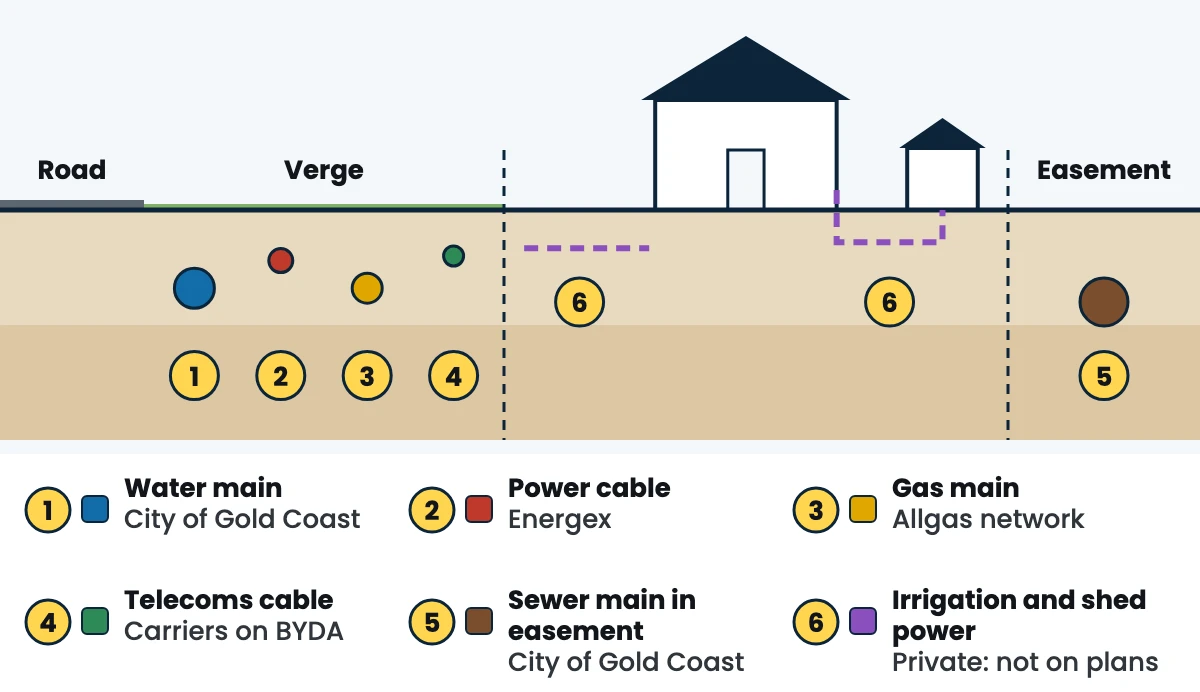
A typical Gold Coast house lot has several owners' assets under it and beside it.
The confirmation sheet from your enquiry lists the registered owners whose networks are near your site.
On the Gold Coast, these are the ones you will usually be dealing with.
Water, sewer and stormwater mains:
City of Gold Coast.
Building work near its pipes is regulated by the Queensland Development Code M P one point four and the City's own guideline.
Electricity:
Energex, across South East Queensland.
Request plans through BYDA.
Where cables of thirty-three kilovolts or higher are present, request detailed plans and submit your works plans to Energex.
Gas:
The All-gas network, which covers the Gold Coast.
Gas information comes with your BYDA response.
BYDA says pressures should be on the plans or in the information pack, or ask the owner.
Telecommunications:
The carriers registered with BYDA.
Follow the instructions in each carrier's response.
Private services:
The property owner.
Not usually on BYDA plans:
ask the owner or occupier, and have them located.
Energex's before you dig page says any work around live underground powerlines is classed as high risk.
It notes protective cover strips or bricks are typically installed about a hundred millimetres above its cables.
Before any work below a cover strip, check Energex's requirements for your site.
Our operator works to the conditions in each owner's response, so send them with your plans when you book.
The AEMC's pipeline register describes the All-gas network as covering part of Brisbane south of the river and the Gold Coast, extending into northern NSW.
BYDA also says not every asset owner is a member yet, and councils are the example it gives.
Check your confirmation sheet for every owner you would expect on your street.
If one is missing, contact them directly before you start.
A locator can also trace services that no owner has mapped.
What the plans will not tell you.
BYDA's answer to "are the plans accurate?" is no:
they are indicative only.
Asset owners record general locations, ground levels change over the years, and many assets went in before today's GPS.
Cables and pipes are not laid in straight lines either, so never assume their depth or alignment.
Your own services are the other gap.
Domestic services usually do not appear on the plans.
The water pipe from the main to your house may show as a simple line or not at all.
Privately installed services, such as irrigation pipes or power run out to a shed, will not be shown.
The Excavation work code says that when you excavate on private property, contact the owner or occupier about buried cables before work starts.
That is why BYDA's next step for homeowners is a skilled locator, and why the Queensland code says excavation should begin with an initial check, such as exposing a short section of the services with water pressure and a vacuum system.
The code calls this potholing.
You can book our service locator or ground penetrating radar work first, so every service is marked on the ground before the vac truck arrives.
The Gold Coast sewer and water pipe rule builders run into.
On the Gold Coast, the City's own pipes add a step many owners do not expect.
The City of Gold Coast's guideline for building over or near Council sewer, water supply and stormwater infrastructure, version three, April 2026, sets out when work near its pipes needs assessment.
Its building work near Council pipes page explains the process.
In short, if your extension, shed or pool will sit close to a City pipe, your certifier checks it against the state rules first, and only some designs go to the City.
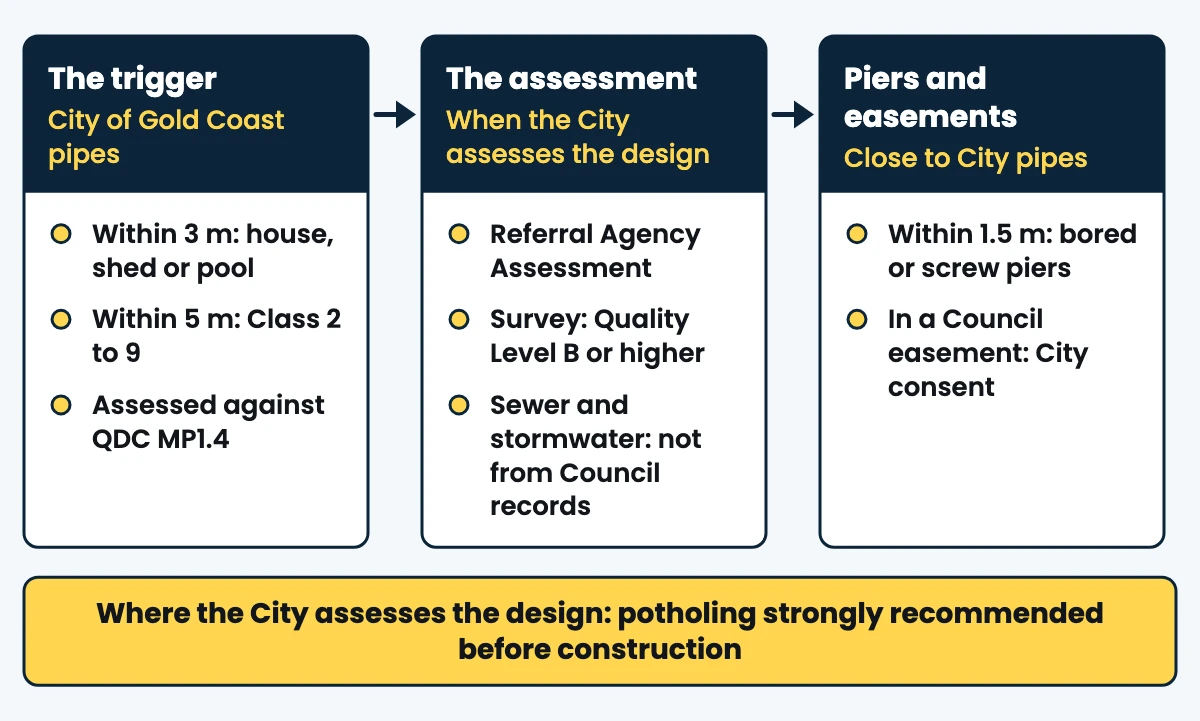
The trigger:
a house, shed, pool or other Class one or ten structure within 3 m of an existing Council sewer, stormwater or water main is assessed against Q D C M P one point four.
For Class two to nine buildings, such as units and commercial buildings, the distance is five metres.
If a house, shed or pool does not meet the acceptable solutions, a Referral Agency Assessment goes to the City.
A Class two to nine building triggered for assessment always needs one.
Inside a Council easement, the City's consent is needed even when the design does comply.
Footings close to a pipe:
any footing within one and a half metres of the infrastructure must be a bored or screw pier.
Some minimum clearances:
600 mm from the edge of a footing to your own sewer property connection, one thousand millimetres to a neighbour's, and one thousand millimetres to a water main in the verge.
The road reserve counts:
the guideline says the certifier must also consider infrastructure in the road reserve next to your lot, not just inside your boundary.
Where the City assesses the design, it wants the pipes surveyed, not copied from its records.
For sewer and stormwater pipes, the guideline asks for an on-site survey signed by a registered surveyor, at Quality Level B or higher under A S fifty-four eighty-eight, and says survey plans plotted from Council records will not be accepted.
For a water main in the verge, field measurements with photos are an accepted alternative.
In that assessment, it says potholing is strongly recommended before construction to locate existing Council infrastructure accurately, so footings, piers and structures are placed to avoid damage.
The guideline also warns that not locating the pipes accurately risks damage, cost and delay, and can affect your neighbours.
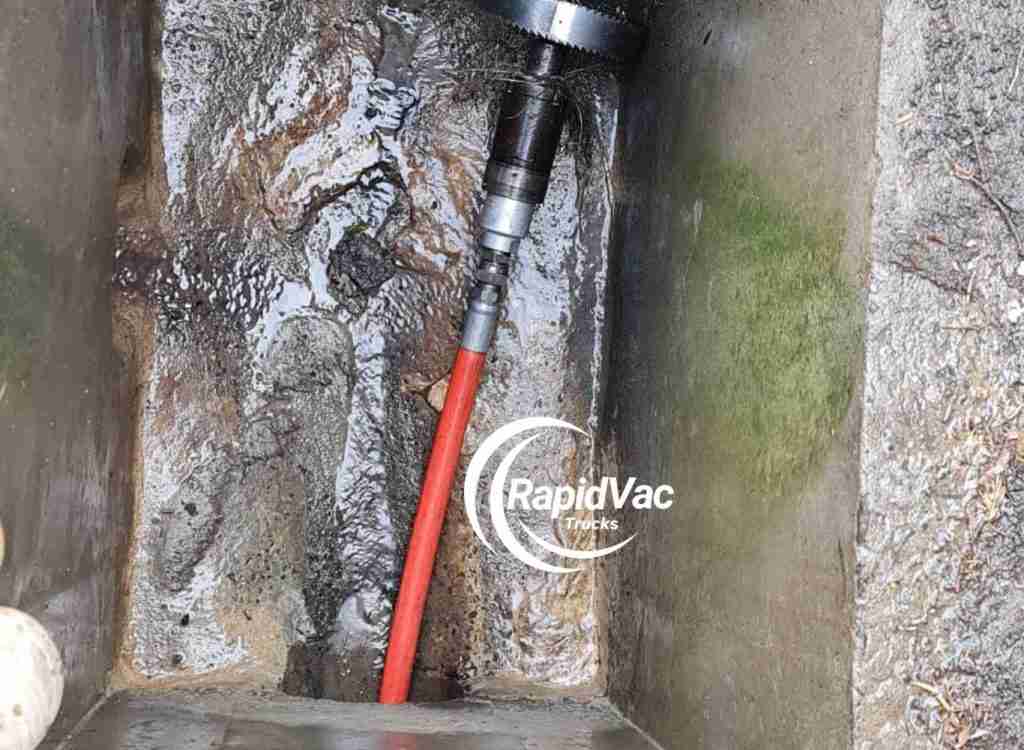
With vacuum excavation, water loosens the soil and suction lifts it into the truck, so the sewer connection, main or water pipe is uncovered without a bucket or blade near it.
Our operator exposes it so its position and depth can be seen, measured and photographed by your surveyor or designer before the design is locked in.
Read more on our non-destructive digging page.
From plans to a safe dig, in five steps.
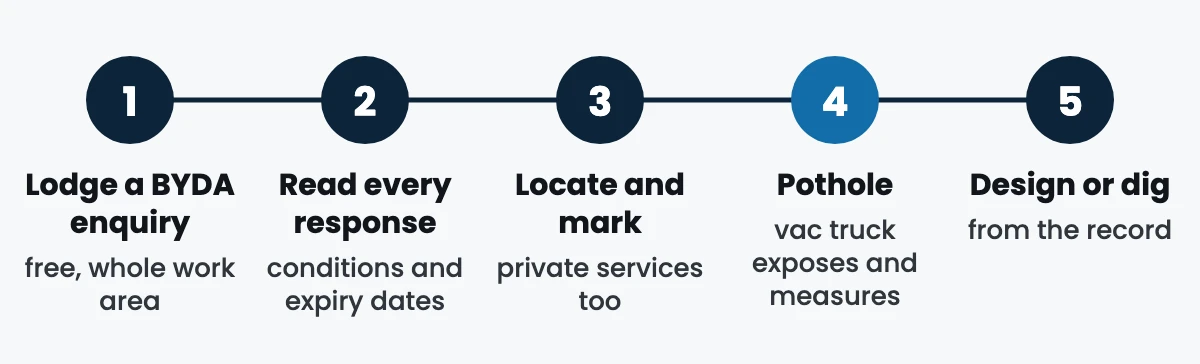
A Gold Coast dig goes in this order:
plans, conditions, locating, potholing, then the work.
Lodge a free BYDA enquiry.
Cover the whole work area, and lodge again if your scope changes or the plans expire.
Read every response.
Check the confirmation sheet against the plans you received, note each expiry date, and follow each owner's conditions, such as Energex's extra steps near cables of thirty-three kilovolts or higher.
Locate and mark.
A locator or ground penetrating radar traces each service and marks it on the ground, including the private services the plans leave out.
Pothole to confirm.
Our operator uses water to loosen the soil and suction to lift it into the truck, one hole at a time, until the service can be seen.
Its depth and position are measured and photographed.
Design, dig or bore from the record.
Keep the record with your plans and hand it to whoever designs the structure or does the main dig.
The code says the underground services information you obtain must be given to the principal contractor or excavation contractor and kept until the excavation work is finished, or for two years after a notifiable incident.
It also says a safe work method statement must be prepared for excavation work involving underground services.
What to send when you book.
Have these ready when you book:
Address and work area:
where the footing, pool, trench or bore will go.
Your BYDA plans:
every response, checked for expiry, plus the confirmation sheet.
The owners' conditions:
for example an Energex works plan review, or a City of Gold Coast referral or easement consent.
The design depth:
footings, a pool shell, a connection or a trench, and how deep it goes.
Private services you know about:
irrigation, shed power, a pool line or an old pipe.
Access:
where the truck can stand, gate widths, overhead lines or trees, and any concrete to lift.
Your SWMS and induction details, if it is a commercial site.
Call zero seven, five three zero zero, two nine one zero to talk it through, or upload photos or a site plan with the quote form.
Plumbers can also read why hydro excavation helps around pipes, and civil crews our guide to vacuum excavation on Gold Coast civil projects.
The team provides twenty-four seven service, including on-site attendance for urgent and after-hours jobs.
Timing depends on the job, its location and the schedule, and is confirmed when the work is scoped.
Frequently asked questions.
Is Dial Before You Dig free in Q L D?
Yes.
Lodging a Before You Dig Australia enquiry is free.
Some asset owners may charge for information on large development or planning enquiries where no excavation is taking place, or for on-site locating of their assets.
What happened to Dial Before You Dig, and who do I call?
It was renamed Before You Dig Australia (BYDA).
You lodge an enquiry on its website or app, and the helpdesk number is one one zero zero.
The asset owners then send their plans to you.
Queensland's Excavation work code still refers to it by the old name.
How long does a Dial Before You Dig enquiry take?
BYDA encourages its members to respond within two business days, so lodge well before your job.
If an owner on your confirmation sheet has not replied, contact them directly using the details on that sheet.
Does Dial Before You Dig show services on private property?
Usually not your own.
BYDA plans mainly show network services, sometimes including ones that pass through a property.
Private services, such as irrigation pipes or power to a shed, are not shown.
The plans are also indicative only and usually give no depth.
A locator can find services, and potholing confirms where they are and how deep.
Do I need to pothole near a City of Gold Coast sewer?
It is the City's advice where it assesses the design.
If your house, shed or pool is within 3 m of a Council sewer, stormwater or water main (five metres for Class two to nine buildings), it is assessed against Q D C M P one point four.
Where the design goes to the City for a Referral Agency Assessment, the guideline strongly recommends potholing before construction to locate the pipe accurately.
Exposing the pipe with a vac truck lets your surveyor or designer measure where it really is.
This guide is general information, not safety, legal or building advice.
Codes, guidelines and asset owner conditions change, so check the current WorkSafe Queensland code, your Before You Dig Australia responses, Energex's requirements and the City of Gold Coast guideline for your site, and ask your certifier about building approvals.
Sources were checked on the thirteenth of November, 2026.
Dial Before You Dig is now called Before You Dig Australia (BYDA), and it is still the free first step before any digging on the Gold Coast. You lodge one enquiry and the registered asset owners near your site send their plans. On the Gold Coast, the networks under and beside a site usually belong to the City of Gold Coast (water, sewer and stormwater), Energex (electricity), the Allgas network (gas) and the telecommunications carriers.
The plans then need checking on the ground. BYDA says they are indicative only, and private services on your own block usually are not on them at all. Rapid Vac Trucks Gold Coast locates buried services and exposes them with a vac truck and operator, so you know where each service is and how deep before the real work begins.
Key takeaways
- Before You Dig Australia is the new name for Dial Before You Dig. A BYDA enquiry is free.
- Queensland's Excavation work code says to get current underground services information before excavation work starts.
- The plans are indicative, usually give no depth and leave out private services such as irrigation or shed power.
- A house, shed or pool within 3 m of a City of Gold Coast sewer, stormwater or water main (5 m for Class 2 to 9 buildings) triggers its own rules. Where the City assesses the design, it strongly recommends potholing before construction.
- Our crew locates and exposes each service, so your design, dig or bore works from measured positions and depths.
Is Dial Before You Dig still around in Queensland?
Yes, under a new name, and it covers QLD like every other state. The federal infrastructure department notes that Dial Before You Dig was renamed Before You Dig Australia, the national referral service. BYDA's FAQs say an enquiry is free and can be lodged through its website or its iPhone and Android apps, and its helpdesk number is 1100. Some asset owners may charge for information, but BYDA says that is normally only for large development or planning enquiries where no excavation is taking place.
Queensland's Excavation work Code of Practice 2021 still uses the old name. It says a person with management or control of the workplace must take all reasonable steps to get current information about underground essential services before work starts, and it lists Dial Before You Dig as a free enquiry service for information on underground assets. The code is an approved code under the Work Health and Safety Act 2011. Under section 26A of that Act, duty holders must comply with it or follow a method that gives an equivalent or higher standard.
Lodge early. BYDA encourages members to respond within 2 business days, and the plans have expiry dates that differ between owners. If a response has not arrived, the owner's contact details are on your Enquiry Confirmation Sheet. Getting every response back is not approval to dig: BYDA says each owner's directions still have to be followed.
Who owns what under a Gold Coast site
A typical Gold Coast house lot has several owners' assets under it and beside it. The confirmation sheet from your enquiry lists the registered owners whose networks are near your site. On the Gold Coast, these are the ones you will usually be dealing with.

| Service | Who owns it on the Gold Coast | What they ask before you dig |
|---|---|---|
| Water, sewer and stormwater mains | City of Gold Coast | Building work near its pipes is regulated by the Queensland Development Code MP1.4 and the City's own guideline (see the next section) |
| Electricity | Energex, across South East Queensland | Request plans through BYDA. Where cables of 33kV or higher are present, request detailed plans and submit your works plans to Energex |
| Gas | The Allgas network, which covers the Gold Coast | Gas information comes with your BYDA response. BYDA says pressures should be on the plans or in the information pack, or ask the owner |
| Telecommunications | The carriers registered with BYDA | Follow the instructions in each carrier's response |
| Private services | The property owner | Not usually on BYDA plans: ask the owner or occupier, and have them located |
Energex's before you dig page says any work around live underground powerlines is classed as high risk. It notes protective cover strips or bricks are typically installed about 100 mm above its cables. Before any work below a cover strip, check Energex's requirements for your site. Our operator works to the conditions in each owner's response, so send them with your plans when you book. The AEMC's pipeline register describes the Allgas network as covering part of Brisbane south of the river and the Gold Coast, extending into northern NSW.
BYDA also says not every asset owner is a member yet, and councils are the example it gives. Check your confirmation sheet for every owner you would expect on your street. If one is missing, contact them directly before you start. A locator can also trace services that no owner has mapped.
What the plans will not tell you
BYDA's answer to "are the plans accurate?" is no: they are indicative only. Asset owners record general locations, ground levels change over the years, and many assets went in before today's GPS. Cables and pipes are not laid in straight lines either, so never assume their depth or alignment.
Your own services are the other gap. Domestic services usually do not appear on the plans. The water pipe from the main to your house may show as a simple line or not at all. Privately installed services, such as irrigation pipes or power run out to a shed, will not be shown. The Excavation work code says that when you excavate on private property, contact the owner or occupier about buried cables before work starts.
That is why BYDA's next step for homeowners is a skilled locator, and why the Queensland code says excavation should begin with an initial check, such as exposing a short section of the services with water pressure and a vacuum system. The code calls this potholing. You can book our service locator or ground penetrating radar work first, so every service is marked on the ground before the vac truck arrives.

The Gold Coast sewer and water pipe rule builders run into
On the Gold Coast, the City's own pipes add a step many owners do not expect. The City of Gold Coast's guideline for building over or near Council sewer, water supply and stormwater infrastructure (version 3, April 2026) sets out when work near its pipes needs assessment. Its building work near Council pipes page explains the process. In short, if your extension, shed or pool will sit close to a City pipe, your certifier checks it against the state rules first, and only some designs go to the City.
- The trigger: a house, shed, pool or other Class 1 or 10 structure within 3 m of an existing Council sewer, stormwater or water main is assessed against QDC MP1.4. For Class 2 to 9 buildings, such as units and commercial buildings, the distance is 5 m.
- If a house, shed or pool does not meet the acceptable solutions, a Referral Agency Assessment goes to the City. A Class 2 to 9 building triggered for assessment always needs one. Inside a Council easement, the City's consent is needed even when the design does comply.
- Footings close to a pipe: any footing within 1.5 m of the infrastructure must be a bored or screw pier.
- Some minimum clearances: 600 mm from the edge of a footing to your own sewer property connection, 1,000 mm to a neighbour's, and 1,000 mm to a water main in the verge.
- The road reserve counts: the guideline says the certifier must also consider infrastructure in the road reserve next to your lot, not just inside your boundary.
Where the City assesses the design, it wants the pipes surveyed, not copied from its records. For sewer and stormwater pipes, the guideline asks for an on-site survey signed by a registered surveyor, at Quality Level B or higher under AS 5488, and says survey plans plotted from Council records will not be accepted. For a water main in the verge, field measurements with photos are an accepted alternative. In that assessment, it says potholing is strongly recommended before construction to locate existing Council infrastructure accurately, so footings, piers and structures are placed to avoid damage. The guideline also warns that not locating the pipes accurately risks damage, cost and delay, and can affect your neighbours.
With vacuum excavation, water loosens the soil and suction lifts it into the truck, so the sewer connection, main or water pipe is uncovered without a bucket or blade near it. Our operator exposes it so its position and depth can be seen, measured and photographed by your surveyor or designer before the design is locked in. Read more on our non-destructive digging page.
Find the pipes before you finalise the design
Call the Gold Coast team to book a locator and a vac truck with operator, or send your plans and photos for a quote.
From plans to a safe dig, in five steps
A Gold Coast dig goes in this order: plans, conditions, locating, potholing, then the work.
- Lodge a free BYDA enquiry. Cover the whole work area, and lodge again if your scope changes or the plans expire.
- Read every response. Check the confirmation sheet against the plans you received, note each expiry date, and follow each owner's conditions, such as Energex's extra steps near cables of 33kV or higher.
- Locate and mark. A locator or ground penetrating radar traces each service and marks it on the ground, including the private services the plans leave out.
- Pothole to confirm. Our operator uses water to loosen the soil and suction to lift it into the truck, one hole at a time, until the service can be seen. Its depth and position are measured and photographed.
- Design, dig or bore from the record. Keep the record with your plans and hand it to whoever designs the structure or does the main dig.
The code says the underground services information you obtain must be given to the principal contractor or excavation contractor and kept until the excavation work is finished, or for two years after a notifiable incident. It also says a safe work method statement (SWMS) must be prepared for excavation work involving underground services.

What to send when you book
Have these ready when you book:
- Address and work area: where the footing, pool, trench or bore will go.
- Your BYDA plans: every response, checked for expiry, plus the confirmation sheet.
- The owners' conditions: for example an Energex works plan review, or a City of Gold Coast referral or easement consent.
- The design depth: footings, a pool shell, a connection or a trench, and how deep it goes.
- Private services you know about: irrigation, shed power, a pool line or an old pipe.
- Access: where the truck can stand, gate widths, overhead lines or trees, and any concrete to lift.
- Your SWMS and induction details, if it is a commercial site.
Call (07) 5300 2910 to talk it through, or upload photos or a site plan with the quote form. You can also find Rapid Vac Trucks Gold Coast on Google Maps. Plumbers can read why hydro excavation helps around pipes, and civil crews our guide to vacuum excavation on Gold Coast civil projects. The team provides 24/7 service, including on-site attendance for urgent and after-hours jobs. Timing depends on the job, its location and the schedule, and is confirmed when the work is scoped.
Know what is under your Gold Coast site
Send your plans and site details, and we will plan the locating and the vac truck and operator around your job.
Frequently asked questions
Is Dial Before You Dig free in QLD?
Yes. Lodging a Before You Dig Australia enquiry is free. Some asset owners may charge for information on large development or planning enquiries where no excavation is taking place, or for on-site locating of their assets.
What happened to Dial Before You Dig, and who do I call?
It was renamed Before You Dig Australia (BYDA). You lodge an enquiry on its website or app, and the helpdesk number is 1100. The asset owners then send their plans to you. Queensland's Excavation work code still refers to it by the old name.
How long does a Dial Before You Dig enquiry take?
BYDA encourages its members to respond within 2 business days, so lodge well before your job. If an owner on your confirmation sheet has not replied, contact them directly using the details on that sheet.
Does Dial Before You Dig show services on private property?
Usually not your own. BYDA plans mainly show network services, sometimes including ones that pass through a property. Private services, such as irrigation pipes or power to a shed, are not shown. The plans are also indicative only and usually give no depth. A locator can find services, and potholing confirms where they are and how deep.
Do I need to pothole near a City of Gold Coast sewer?
It is the City's advice where it assesses the design. If your house, shed or pool is within 3 m of a Council sewer, stormwater or water main (5 m for Class 2 to 9 buildings), it is assessed against QDC MP1.4. Where the design goes to the City for a Referral Agency Assessment, the guideline strongly recommends potholing before construction to locate the pipe accurately. Exposing the pipe with a vac truck lets your surveyor or designer measure where it really is.
This guide is general information, not safety, legal or building advice. Codes, guidelines and asset owner conditions change, so check the current WorkSafe Queensland code, your Before You Dig Australia responses, Energex's requirements and the City of Gold Coast guideline for your site, and ask your certifier about building approvals. Sources were checked on 13 November 2026.